



Classification of the Smooth-Coated Otter
The relationship of the Smooth-Coated otter to the other otters has long been in confusion.
 Right from the beginning, this animal has been confused with the Asian Small-Clawed Otter,
Amblonyx cinereus, and the Eurasian Otter, Lutra lutra.
According to Harris (1968),
the species was first described as Lutra perspicillata by Geoffroy in 1826, although it is
possible that he meant the Small-Clawed Otter. Lesson, in 1827, called it Lutra simung,
but Elliot, in 1839, called it Lutra nair. This opened up a whole new can of worms -
Cantor (1846), Jerdon (1874), Anderson (1878), Blasndford (1888) and Flower (1929) also spoke
of Lutra nair, but it is possible that they were really referring to the Eurasian Otter,
Lutra lutra instead.
Right from the beginning, this animal has been confused with the Asian Small-Clawed Otter,
Amblonyx cinereus, and the Eurasian Otter, Lutra lutra.
According to Harris (1968),
the species was first described as Lutra perspicillata by Geoffroy in 1826, although it is
possible that he meant the Small-Clawed Otter. Lesson, in 1827, called it Lutra simung,
but Elliot, in 1839, called it Lutra nair. This opened up a whole new can of worms -
Cantor (1846), Jerdon (1874), Anderson (1878), Blasndford (1888) and Flower (1929) also spoke
of Lutra nair, but it is possible that they were really referring to the Eurasian Otter,
Lutra lutra instead.
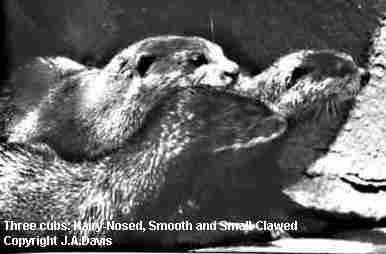
In 1859, Hodgeson described it as Lutra tarayensis, followed by Wroughton (1919) and Allen (1935). Gray called it Lutra indica in 1865, but Dammerman confused things again in 1929 by naming it Lutra sumatrana, which is now used to refer to the Hairy-Nosed Otter. Thomas plumped for Lutra barang in 1889, presumably so we could confuse it with the Indonesian subspecies of the Eurasian Otter, Lutra lutra barang. Pohle threw in Amblonyx cinerea perspicillata in 1920, regarding it as a big subspecies of the Asian Small-Clawed Otter. Reference to the illustration, copyright and by permission of J.A. Davis, of a Smooth Otter cub and a Small-Claw cub show how unlikely this seems today.
In 1941, Pocock decided to move this animal to a new genus, and it became Lutragale Macrodus, but in the same year, he changed his mind, and called it Lutrogale perspicillata, and Hayman (1957) agreed with him. Since then, in the absence of any DNA evidence, Lutrogale perspicillata is what this animal is known as.
Harris records three subspecies of Lutra perspicillata, based on size and colouring:
- Lutrogale perspicillata perspicillata(Geoffroy, 1826): large dark chestnut brown animal with a paler belly and feet, and a whitish chin.
- Lutrogale perspicillata sindica (Pocock, 1949): smaller, paler animal, ranging from tawny to greyish; found in the Indus Valley, Pakistan.
- Lutrogale perspicillata maxwelli (Hayman, 1957): very dark brown, with the underside only very slightly paler, with an iron grey chin; this is Gavin Maxwell's famous Mijbil, and he and the other type specimen, a skin, were found in the marshes of the Tigris-Euphrates, in modern Iraq. Since then, there have been no reports of this animal and it was supposed extinct, but Farsi sources reported in Ziaie & Gutleb (1997) indicate that in adjoining part of Iran, this animal was present in 1972, so it is possible that Mij's relations are still alive and well. AND IT IS!
 In 2004, Klaus-Peter Koepfli
did the DNA analysis for this species, and the result surprised everyone -
cladistically,Smooth-Coated Otters are next to the Asian and African Clawless
Otters! (Koepfli
et al, 2008).
In 2004, Klaus-Peter Koepfli
did the DNA analysis for this species, and the result surprised everyone -
cladistically,Smooth-Coated Otters are next to the Asian and African Clawless
Otters! (Koepfli
et al, 2008).
Other Names for the Smooth Otter
English : Smooth Otter, Smooth-Coated Otter, Indian Smooth-Coated Otter
Spanish: Nutria Lisa, Nutria Simung
German: Glattotter, Indischer Fischotter
French: Loutre d'Asie, Loutre à Fourrure Unie
Italian: Lontra Liscia, Lontra Asiatica
Dutch: Indiase Otter
Vernacular: berang-berang bulu licin
| Smooth-Coated Otter |