



Reproduction in the Smooth-Coated Otter
This account is taken from the obervations of the wild animal in the
Sungei Buloh Nature Reserve, and the information about breeding in captivity
given in
Badham (1973),
Desai (1974),
Duplaix-Hall (1972),
Hussain (1996),
Sivasothi (1998)
and Yadav (1967).
The picture is courtesy of J.A. Davis, who holds the copyright.
Females have monthly oestral cycle, with swelling of the vulva and nipples at oestrus, during which time they are friendly to the male but aggressive towards keepers. According to Yadav, oestrus lasts a minimum of 14 days, which seems rather a long time! Depending on weather conditions and food sources, breeding may take place all year round; in areas with monsoon seasons, breeding tends to be confined to that time, as water-dwelling food is more abundant then. Mating takes place in water after an extended and noisy play period. After mating, they both groomed together. After oestrus ended, the female became aggressive towards the male and attacked him if he attempted to mate with her. The otters form monogamous pairs, with strong pair bonding, and the female is dominant.
After 63-65 days, the female gives birth. The only sign of pregnancy seems to be that the female becomes very sluggish. Just before the birth, she will start excavating a burrow, and her nipples will become swollen. The natal burrow, according to Badham, has several chambers, one of which will be around 50x25cm and carefully lined with straw; this will be kept scrupulously clean. In the wild, this burrow is near water. Sivasothi surveyed 20 litters and found cub numbers range from one to five with an average of three per litter. The female remains in the burrow for the first couple of days, permitting no other otter to enter, but changing the bedding regularly. There is a post-partum oestrus in this species.
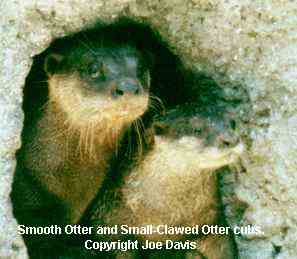 The puppies (as cubs of this species are called
in Singapore) are born with their eyes tight shut, and open them at about 10 days.
The young emerge after about four weeks, carefully guarded by the mother, and kept away from
the water. The male is kept at a distance, although he displays interest in the cubs.
The cubs are introduced to the water at about 12 weeks, and at this time, the male is
accepted as part of the group. If the cubs stray, the father picks them up in his mouth and
carries them back between chin and forepaw. The cubs try their first piece of fish at eight
weeks, and are weaned after about 19 weeks. In captivity, the cubs seem to be allowed
to eat first, and then the female; the male not only waits until the rest have finished, but
in some cases, the male gives food he has been given to the female and cubs.
The puppies (as cubs of this species are called
in Singapore) are born with their eyes tight shut, and open them at about 10 days.
The young emerge after about four weeks, carefully guarded by the mother, and kept away from
the water. The male is kept at a distance, although he displays interest in the cubs.
The cubs are introduced to the water at about 12 weeks, and at this time, the male is
accepted as part of the group. If the cubs stray, the father picks them up in his mouth and
carries them back between chin and forepaw. The cubs try their first piece of fish at eight
weeks, and are weaned after about 19 weeks. In captivity, the cubs seem to be allowed
to eat first, and then the female; the male not only waits until the rest have finished, but
in some cases, the male gives food he has been given to the female and cubs.
The young may leave their parents or stay to form a larger group: family groups are seen that comprise the parents and the cubs of more than one season. Young otters breed at two or three, and there is some evidence from Yadav that young females may be in conflict with their alpha female mother. It would be interesting to know the sex composition of the larger groups seen in the wild, to find out if the retained young of previous years tend to be male.
The life expectancy of this species in the wild is unknown; in captivity, they
live to at least 10, usually 12, and occasionally 20+.
| Smooth-Coated Otter |