



Social Behaviour of the Neotropical Otter
This is mostly from the University of Michigan Animal Diversity Web, (Pardini & Trajano (1999) and Larivire (1999).
Territory
Almost nothing is known about territories. One study in Argentina showed an otter density of 0.8 otters per km along the coast, and here the otters lived a diurnal and solitary lifestyle (IOSF Website).
Holt
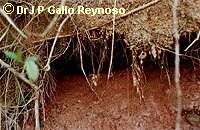 Neotropical
Otters do dig burrows, but not the extensive systems with exit holes
underwater seen in, for example, the Eurasian and Smooth-Coated Otters.
They do make extensive use of natural cavities in their environment
(See Habitat and Home), including
caves, which no other otter is known to regularly make use of. Sites with
low risk of flooding are preferred, and certain favoured locations may be
frequently re-used.
Neotropical
Otters do dig burrows, but not the extensive systems with exit holes
underwater seen in, for example, the Eurasian and Smooth-Coated Otters.
They do make extensive use of natural cavities in their environment
(See Habitat and Home), including
caves, which no other otter is known to regularly make use of. Sites with
low risk of flooding are preferred, and certain favoured locations may be
frequently re-used.
Daily Activity
In the absence of human pressure, the Neotropical Otter is thought to forage by day, especially in the middle and late afternoon. In areas with greater human presence or disturbance, otters are becoming increasingly nocturnal, as has been found with other species. The daily activity cycle of preferred or plentiful prey may also affect daily activity.
Sociability
This species does not appear to be social. The female only tolerates the male during oestrus, and, like the Eurasian Otter, groups of otters seen together appear to be females with cubs.
| Neotropical River Otter |