



Classification of the Neotropical Otter
When men of science first started naming the animals of central and south America, they found a lot of similar otters differing in rhinarium form, and rather less in size, colouring and claw development.
 |
||
| These excellent drawings by J.A. Davies (in Proceedings of the First Working Meeting of the Otter Specialist Group, 1977) show the range of variation in the otters that would eventually all become Lontra longicaudis. | ||
| 1818 | Olfers named a medium sized river otter from southern Brazil Lutra longicaudis | |
| 1823 | Cuvier identified a species of river otter from the coasts of eastern Venezuela through Trinidad down the east coast of Brazil as Lutra enudris, splitting it into three subspecies: L. e. enudris, L. e. insularis, and Thomas added L. e. mitis. | |
| 1838 | Lutra longicaudis renamed (or re-discovered) Lutra platensis by Waterhouse. | |
| 1897 | Major identified a species ranging from Mexico to northern Ecuador and called it Lutra annectans. This was subsequently split into five subspecies: L. a. annectens, L. a. colombiana, L. a. latidens, L. a. paralina, L. a. repanda. | |
| 1908 | Thomas named the otter of the Peruvian coast Lutra incarum. | |
| 1924 | Cabrera identified the otter of Costa Rica as Lutra mesopetes. | |
By the 1930s, there were six species of Central and South American medium-sized river otters, with eight further subspecies divisions. People began to suspect that there was something wrong with this scenario. Some people, such as J.A. Davies, who had immense experience in working with the American river otters, felt that L. canadensis, longicaudis, provocax and felina were subspecies of a single species.
 Van
Zyll de Jong did much work reviewing the classification of the New World
Otters based on morphology and anatomy, and came to the conclusion that
the River Otters of the New World were not so closely related to the Old
World ones, and proposed the generic name Lontra for them. He further
suggested that all apart from L. canadensis (the North American
River Otter) and L. felina (the Marine Otter or Sea Cat) were all
one species, with a variable rhinarium shape (Van Zyll de Jong 1972,
1987, 1991);
he gave it the oldest valid name for the whole lot, Lontra longicaudis.
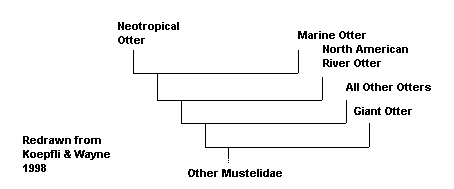
Koepfli & Wayne's 1998
work on cytochrome b variations between different species of otters
supported this, and in their 2003
paper, five other genetic markers agreed that the three similar Lontra
species, L. canadensis, L. longicaudis and L. felina
form a fairly tight monophyletic group. They suggest that the Neotropical
and Marine Otters are the least different from each other of any otter
species, and diverged about 1.7 mya, possibly as L. canadensis
radiated through Central and South America after the formation of the
Panamanian landbridge 203 mya.
Van
Zyll de Jong did much work reviewing the classification of the New World
Otters based on morphology and anatomy, and came to the conclusion that
the River Otters of the New World were not so closely related to the Old
World ones, and proposed the generic name Lontra for them. He further
suggested that all apart from L. canadensis (the North American
River Otter) and L. felina (the Marine Otter or Sea Cat) were all
one species, with a variable rhinarium shape (Van Zyll de Jong 1972,
1987, 1991);
he gave it the oldest valid name for the whole lot, Lontra longicaudis.
Koepfli & Wayne's 1998
work on cytochrome b variations between different species of otters
supported this, and in their 2003
paper, five other genetic markers agreed that the three similar Lontra
species, L. canadensis, L. longicaudis and L. felina
form a fairly tight monophyletic group. They suggest that the Neotropical
and Marine Otters are the least different from each other of any otter
species, and diverged about 1.7 mya, possibly as L. canadensis
radiated through Central and South America after the formation of the
Panamanian landbridge 203 mya.
So now we have one, highly variable species, the Neotropical Otter, Lontra longicaudis (the Long-Tailed Otter). Of course, the Neotropical Otter is currently split into three subspecies . . .
Other Names for the Neotropical Otter
| English | Brasilian Otter, Long-tailed Otter, Neotropical Otter, Neotropical River Otter; South American River Otter; ;La Plata Otter |
| Spanish | Lobito de Rio, Nutria, Gato de agua, Lobito de Gato de agua, Lobito del Plata, Lobito de ro, Nutria del Per, Nutria peruana, Nutria de agua, Nutria de cola larga, Perro de agua, Taira,Nutria del dooeste, Nutria brasilea, Nutria de Brasil, nutria verdadera, lobito comun, cachorro d'agua, watradagoere |
| French | La plata, Loutre longue queue, Loutre d'Amrique du Sud, Loutre du Prou, Loutre du Brsil, Loutre notropicale; Loutre de Rio |
| German | Sudamerikanischer FischOtter, Sdamerika-Fischotter, Mittelamerikanischer Fischotter, Peru-Otter; Brasilianischer Flussotter |
| Italian | Lontra di fiume, Lontra a coda lunga del C. e S. America, Lontra dell' America centrale, Lontra del Brasile |
| Dutch | Langstaartotter |
| Finnish | Neotropiikinsaukko |
| Swedish | centralamerikansk utter, lngsvansad utter, neotropisk flodutter |
| Bolivia | Lobito Comn |
| Argentina | Lobito de ro |
| Peru | pisua, parari, mayupuma |
| Fur Trade name | South American Otter |
| Neotropical River Otter |