



Appearance and Anatomy of the Neotropical Otter
 This
information comes from Gallo-Reynoso (2002), Parera (1996), van Zyll de
Jong (1987), Larivire 1999, Otternet,
This
information comes from Gallo-Reynoso (2002), Parera (1996), van Zyll de
Jong (1987), Larivire 1999, Otternet,the River Otter Preservation Society, and the IUCN (otter noses one). Special thanks to Dr Juan-Pablo Gallo-Reynoso and Dr Elton Pinto Colares who let me use their copyright images.
Summary
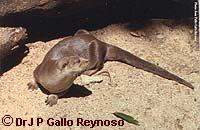
This is an average sized, robustly built otter, very similar in appearance to the other American river otters. The tail can be notably long, forming more than a third of the body length.
Size
| Sex | Body Length | Tail Length | Total Length | Weight |
| Male | 83 - 97 cm | 55 - 65 cm (16- 20") |
138 - 162cm (42 - 51") |
16.3 - 24kg (16- 25lb) |
| Female | 65 - 76 cm | 44 - 51 cm | 109 - 127 cm | 12.5 - 15kg |
The species shows sexual dimorphism - the male is generally 20-25% larger than the female. Larivire seems to have examined smaller animals - he gives weight as less than 12kg, head and body length 36-66cm, tail 37-84cm, but agrees on the dimorphism ratio.
Head and Teeth
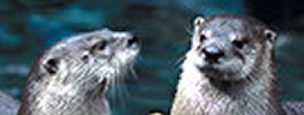 The head of the Neotropical Otter is very similar to that of the North
American River Otter - a long, flat skull and a short, broad muzzle, all
rounded in shape, and with numerous long, strong vibrissae. The small,
round ears and eyes are set high on the head, in the typical otter
fashion. The neck is thicker than the head.
The head of the Neotropical Otter is very similar to that of the North
American River Otter - a long, flat skull and a short, broad muzzle, all
rounded in shape, and with numerous long, strong vibrissae. The small,
round ears and eyes are set high on the head, in the typical otter
fashion. The neck is thicker than the head.
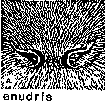
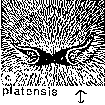
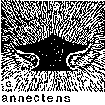
The black, hairless rhinarium, or nose pad, the traditional way to distinguish species of New World Otters, is very variable in this species. There seems to be regionalisation of different forms, and the three currently recognised subspecies are characterised as having specific forms, but there is a great deal of variation - all that can be said is that in this species, the rhinarium is smaller than in the North American River Otter to the north and the Southern River Otter to the south of the Neotropical Otter's range.
 |
 |
 |
Van Zyll de Jong considers that the crowns of the teeth in Lontra species is wider than in Lutra species, corresponding to the greater proportion of invertebrates with hard shells in the diet; Aonyx, even more of an invertebrate specialist has even wider molars with reduced cusps.The dental formula is the usual one for otters other than Aonyx cinereus and Enhydra lutris:
Body
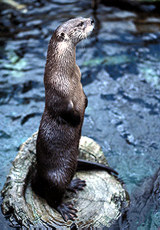 The Neotropical Otter has the classical otter shape. It is robustly
built. The females have four nipples low on the abdomen. The male
baculum is well-developed, with a small ventral groove shallow
proximally, deepening distally, around 72mm long. Like other otters,
the animals have a pair of anal scent glands, which produce a liquid
which is added to spraint, and is almost certainly conveys information
about sex, sexual state and receptivity, and maybe identity.
The Neotropical Otter has the classical otter shape. It is robustly
built. The females have four nipples low on the abdomen. The male
baculum is well-developed, with a small ventral groove shallow
proximally, deepening distally, around 72mm long. Like other otters,
the animals have a pair of anal scent glands, which produce a liquid
which is added to spraint, and is almost certainly conveys information
about sex, sexual state and receptivity, and maybe identity.
Tail
The tail of this species is notable for its length in proportion to the body. The relative length varies but may form a third of the total body length. It is cylindrical and tapers evenly to the tip.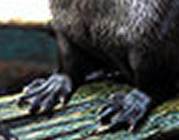 Legs and Paws
The
legs are short, stocky and strong, with the hind legs being longer
than the forelegs. The paws are small, wide and strong, with five toes
on each, fully webbed to the ends of the digits, hairless underneath
and bearing strong claws.Fur
The fur is short, dense and sleek, with coarse, shiny guard hairs
overlaying a soft, woolly undercoat which traps air to keep the animal
warm and insulated (otters have no insulating subcutaneous fat layer
for insulation). The guard hairs are 12 -14mm long, and the underfur 7
- 9mm long. The colouration is lustrous dark greyish brown
dorsally, becoming paler along the sides of the body, turning
paler brown to cream ventrally. The throat and lip area is much
paler, being cream or white in some animals, who may also show
individual dark, pale, yellow, cream or white colouration and spotting
on the chin and throat; the upper lip, mandible and tip of the muzzle
are silvery white to yellowish.
| Neotropical Otter |