



Hunting and Feeding in the Marine Otter
The information below comes from Cabello, Medina and Brownell in
Otters: Proceedings of the First Working Meeting of the Otter Specialist Group (1977),
Ostfeld (1989), and
Larivière (1998).
Prey
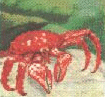 The main food of the Marine Otter is Crustaceans, Molluscs and Fish, though the proportion varies with location. they prefer omnivorous or carnivorous prey from the inter/sub tidal zone - for example, they rarely take echinoderms despite their abundance.
The crustaceans which usually form the major part of their food and mainly crabs, such as the Chilean King Crab or la Centolla (Lithodes antarctica). They also have a taste for freshwater prawns (Criphiops caementarius), and will follow freshwater streams high above sea level to find them (Hernandez in Brownell in IUCN: Otters (1977)).
The main food of the Marine Otter is Crustaceans, Molluscs and Fish, though the proportion varies with location. they prefer omnivorous or carnivorous prey from the inter/sub tidal zone - for example, they rarely take echinoderms despite their abundance.
The crustaceans which usually form the major part of their food and mainly crabs, such as the Chilean King Crab or la Centolla (Lithodes antarctica). They also have a taste for freshwater prawns (Criphiops caementarius), and will follow freshwater streams high above sea level to find them (Hernandez in Brownell in IUCN: Otters (1977)).
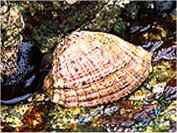 The other major component of their diet is Molluscs, mainly being limpets, or Lapa (Fisurella and Collisella spp) and the limpet-like snail Concholepus concholepus, the Loco. They also take bivalves, octopus and cuttlefish.
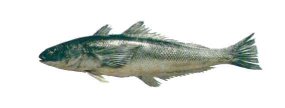 Fish as caught as well. Mostly small or medium-sized species are taken (up to 60cm long), but occasionally an otter will successfully catch and eat a fish almost as big as itself. Species eaten include the Patagonian Blennie or Rock Codling (Eleginops maclovinus), the Whitemouth Croaker (Micropogon furnieri), and the Toad Fish (Aphos porosus), as well as Blennies (Blennidae), Morwongs (Cheilodactylidae), Clingfishes (Gobiesocidae) and Damselfish (Pomacentridae). Birds and small mammals have also occasionally been taken.
Faecal analysis has showed that in season, the otters seek out and eat the fruit of the Bromeliaceae in the coastal vegetation. A mild liking for fruit has been noted in captive otters of other species (Stephen Eddy, Per. Comm. 2001, Pers. Obs.) - perhaps they need the vitamin C content, as this is something that has be supplied in captivity. Algae remains are also found in spraints, but this is probably accidentally ingested with prey.
Hunting Schedule
These animals are apparently diurnal (though there has been no work done on nocturnal activity). They spend 2-0 - 40% of their time hunting or feeding, and precise schedule depends on prey at a specific location. Some hunt at dawn; all show a peak in activity around 2pm (possibly when the sea warms up a bit?), and another at dusk. Hunting schedule seems to be independent of sea state or tides.
Hunting Methods
Hunting begins with swimming up to 100m (300') offshore (never more than 500m/1650'), and diving next to a rock with abundant seaweed. They do not spot their prey from the surface, but immediately descend 30 - 40m (100') and start searching, sometimes travelling 50m (160') along the bottom. They are not tool users as far as we know.
Small prey are eaten in the water, sometimes with the otter lying on its back, keeping its position with its tail. Larger prey and crabs are taken to shore, sometimes carried by mouth, sometimes rested on the belly as the otter swims on its back; very occasionally, a fish as large as the otter is caught, and a pair, or on another occasion, a mother and cub, have been seem co-operating to carry the fish - one holding the head in its mouth, the other the tail, and both executing a series of synchronised shallow dives as they bring the fish to shore.
On land, prey is eaten on the rocks (such as the prominent "Comederos") or more usually taken to the den (perhaps because it is warmer and gulls will not steal the food). Crabs are turned on their backs, the carapace prized off, and the inside eaten; the legs are usually discarded. This species shows about 30% hunting success, which seems to be independent of dive lengths or prey size.
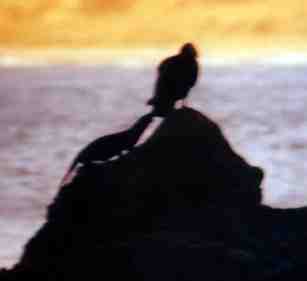
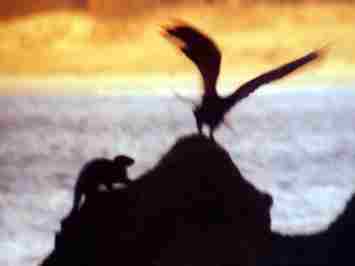
Though small, marine otters will take on anything that looks like a possible meal. In the extraordinary
sequence of photographs below, taken by Hector Carrasco and appearing with his permission, we see
one creeping up on a bird that looks at least twice its size.
The otter sneaks up the rock.
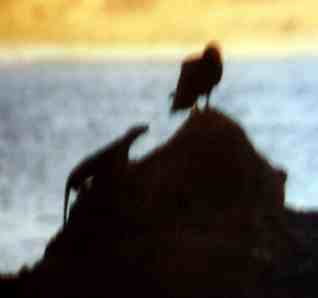
Attack!
Escape!
| Marine Otter |