



Appearance and Anatomy of the Marine Otter
 The information below comes from
Harris (1968),
Larivière (1998),
and material by Jan Reed-Smith,
provided by Gonzalo Medina (pers. comm. 2001).
The information below comes from
Harris (1968),
Larivière (1998),
and material by Jan Reed-Smith,
provided by Gonzalo Medina (pers. comm. 2001).
Summary
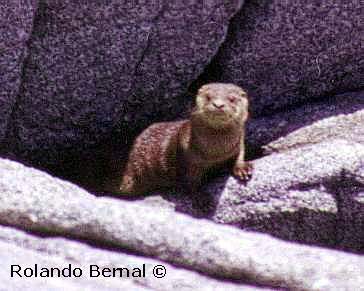
This is the smallest of the New World Otters, and is the normal otter shape - long body, flat head, broad, whiskered muzzle - although the tail is relatively short.
Size
| Sex | Total Length | Tail | Weight |
| Both | 83 - 115cm (32 - 45") |
30 - 36cm (12 - 15") |
3.2 - 5.8kg (7 - 13lb) |
This species displays no sexual dimorphism.
Head and Teeth
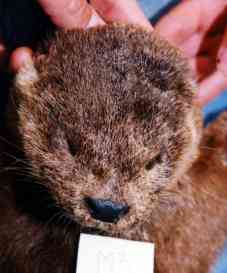 The head is small, flattened, and short facially, with a rather
cat-like appearance (supposedly!). It does resemble the Asian Small-Clawed Otter (
Amblonyx cinereus) facially, rather than the more closely related North American
River Otter (Lontra canadensis). The skull basal length
does not exceed 10cm and has a straight rear profile. The small ears are around 1.5cm long.
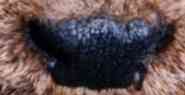
The nose is a flattened reverse rhombus, the rhinarium naked, with nostrils widely spaced at
either side.
The head is small, flattened, and short facially, with a rather
cat-like appearance (supposedly!). It does resemble the Asian Small-Clawed Otter (
Amblonyx cinereus) facially, rather than the more closely related North American
River Otter (Lontra canadensis). The skull basal length
does not exceed 10cm and has a straight rear profile. The small ears are around 1.5cm long.
The nose is a flattened reverse rhombus, the rhinarium naked, with nostrils widely spaced at
either side.
 Strong vibrissae spring from above the upper lip and below the corner of the mouth.
The teeth are strong, large and compressed, more developed for slicing than crushing. The dental formula is
I 3/3 C 1/1 P 3-4/3 M 1/2 = 36
Body
A typical otter body. The female has four teats as is usual.
Tail
The tail in this species is relatively short compared to its body length. It is, as usual, cylindrical, slightly flattened beneath.Legs and Paws
Short, strong legs end in powerful webbed feet. The webbing has scattered hairs above, but is naked beneath, and does not extend to the very ends of the strong toes, which are equipped with blunt claws. The hind feet are moderate in size compare to the body, about 10cm long.Fur
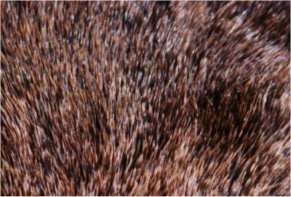 In this species, unlike other otters, the fur is semi-erect and
rather harsh, unlike the thick plush of other otters. This may be an adaptation to living in
rough seas - the idea has been put forward that it offers more protection when being dashed
against rocks than a smooth coat. Alternatively, it may be the effect of constant exposure to
salt water, as this species does not seem to require fresh water for coat washing (unlike
other non-Enhydra
In this species, unlike other otters, the fur is semi-erect and
rather harsh, unlike the thick plush of other otters. This may be an adaptation to living in
rough seas - the idea has been put forward that it offers more protection when being dashed
against rocks than a smooth coat. Alternatively, it may be the effect of constant exposure to
salt water, as this species does not seem to require fresh water for coat washing (unlike
other non-Enhydra
In colour, the adult animal is dark coffee brown, slightly paler beneath, darkening slightly towards the tail, with paler patches on the chin, cheeks and throat - in short, a darker version of the normal otter colour pattern. The 20mm guard hairs are lighter-tipped, which can give a grizzled appearance. The 12mm underfur is brownish-grey, sometimes with a blueish cast. Most authorities report the juveniles as slightly darker, but Cabello in IUCN: Otters(1977) says "En los juveniles el dorso es más amarillento" which I think means "In the young, the back is yellowish".
| Marine Otter |