



Reproduction in the Asian Small-Clawed Otter
Because there has been little long-term observation of this species in the wild, most of what we know about their life cycle comes from observations of captive animals. The information below comes from Lancaster (1975), Prima (1992) and the Cheyanne Mountain Zoo.This species' oestral cycle is 24-30 days, with a 3-day oestrus, indicated by a swollen vulva and rubbing of the female's underside along the ground. Breeding is thus not seasonal. The otters form monogamous pairs that mate for life, with the female being dominant. Mating usually takes place in water, but is sometimes seen on land.
As the end of the 60-64 day gestation period approaches, the male will start carrying nest material into the den. 1-6 altricial young, weighing 40-50g, are born. Small and helpless, they rely on their mother's milk, which is very rich - 6 times more fat than cow milk. They grow a set of deciduous (milk) teeth, and their eyes open at 40 days. During this period, the male hunts for the female.
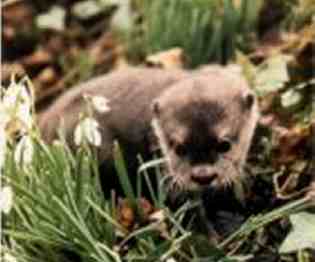 The pupsappear outside holt at around 7 weeks, and their mother teaches them to swim
between 9 weeks and 12 weeks. They begin to take solids at 80 days.
During initial weeks of weaning, cubs are rolled on their backs with parents making
mouth to mouth contact - whether transfering food or saliva is unknown. Both
parents rear the young.
The pupsappear outside holt at around 7 weeks, and their mother teaches them to swim
between 9 weeks and 12 weeks. They begin to take solids at 80 days.
During initial weeks of weaning, cubs are rolled on their backs with parents making
mouth to mouth contact - whether transfering food or saliva is unknown. Both
parents rear the young.
There may be 2 litters annually, and at 1 year, the young may leave the family and set off to find their own mate and territory, or may stay to form a larger family group. Extended families of 15-20 have been seen in the wild. The older siblings help with raising the young, bringing in nest matereial and hunting and delivering food to the mother and pup. Only the original parents, the alpha pair, will breed. Young otters become sexually mature at 2 years, but do not usually breed till 3.
The life expectancy of this species in the wild is unknown; in captivity, they live to at least 10, usually 12, and occasionally 20+.
| Asian Small-Clawed Otter |